Tuesday, October 23, 2012

Now is a Great Time to Replace Your Old Inefficient Heating and Cooling System!


Don’t put it off another year praying and hoping it will last! All of us want to spend our money on something else other than our heating and cooling systems. A new 60” TV, a new boat, car, clothes, ATV, a vacation, anything but a new heating and cooling system, right!?

Any heating and cooling system that is older than 12 years old needs to be considered for replacement. If you are having repeated repairs, or if your utility bills have gotten out of hand, and your system is way out of warranty, now is the best time to replace it. I know, I know, it does cost a lot of money to replace a heating and cooling system, but it is a necessary evil of owning a home. Just like your roof or appliances, your heating and cooling equipment has a useful life and when it reaches a certain age and condition, it must be replaced.

The fall and spring are the best times to have a system replaced because of the different promotions going on. Most manufacturers have rebate or financing programs that will save you hundreds of dollars, some utility companies offer rebates as incentives to purchase higher efficiency models, and there are still a few Federal Tax Credits available as well.

All Seasons has special promotions in addition to the above money saving promotions. Check out our “specials” tab.

A word of caution, all companies are not the same. The best companies train and certify their technicians on an ongoing basis to offer you the best possible service and expertise. You should ask for a certificate of insurance to be certain the company is licensed and insured. Make sure the company has workers' compensation insurance because if a worker gets hurt on your property, you can be held responsible if they do no have workers' compensation insurance. Remember if they do not have a business license or are not insured; you will be stuck with their workmanship or lack of it with no recourse. Most HVAC companies are excellent and honest, but there are a few that are not. Be smart and do your homework so you are not one of the horror stories that you hear about.

Tuesday, October 2, 2012

Furnace Precision Tune Up

It is the perfect time to get your furnace precision tune up now before we hit the cooler fall months, or have a cold snap that takes you by surprise. Manufacturers recommend routine maintenance on your heating and cooling products because it will extend the overall life of your system. We have had some beautiful days this past week and hopefully the 90 and 100 degree days will be a memory for us. So as the cool down of fall is upon us, here are a few reasons you should get your system precision tune up now:

  • Extend your equipment life
  • Help prevent health and safety risks
  • Save money with improved efficiency
  • Catch minor issues before they become major expensive ones
Semi-annual maintenance may extend the life of your furnace or heat pump system.  Having a precision tune up performed helps your system run at its highest level of efficiency. Higher efficiency leads to less energy use and less energy use leads to lower utility bills which can pay for the tune up and is great for our environment. When you have a professional tune up performed on your furnace or heat pump; you are also getting the peace-of-mind knowing your equipment has been thoroughly inspected for safety risks. A tune up may find minor problems and by having them repaired now can save you money and inconvenience in the future. 

Be sure to contact us to schedule your precision tune up. A little prevention and regular attention to your furnace or heat pump now will benefit you going forward. We look forward to serving you soon.

Note: Be sure to replace your carbon monoxide monitor and or smoke detector batteries now. If your devices are older than three years old, please replace them. Their sensors are less effective after that age and offer little if any protection.

Friday, September 14, 2012

Avoid Water Damaged Ceiling and Property!


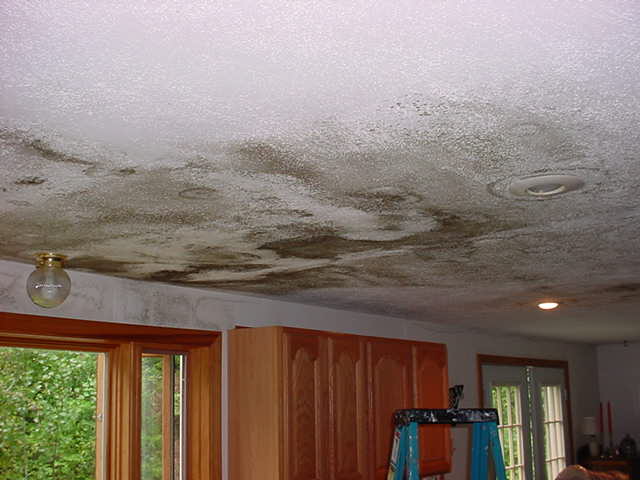
  Do you have or have you seen unsightly water spots or bulges in your ceiling? This damage may be caused by a roof leak, plumbing issue, or your air conditioning indoor unit. My air conditioner, really?!

If you have a split system--central air conditioner or heat pump with the indoor unit located in your attic space, you may have serious water issues just lurking. A split system is a heating and cooling system that has two separate cabinets. The unit located outside in your yard is called the condenser unit and the unit located inside your house (in an attic, knee wall space, or in a closet) is called your air handler or furnace and coil.

On a hot humid day, your air condenser can remove up to 20 gallons of water. This water is called condensate and drips off your indoor air handler refrigerant coil into a pan which takes the condensate water outside of your home by a PVC pipe system. This is fine and dandy and how it is supposed to work and it does work perfect most of the time. 20 gallons of water is a lot of water folks and your AC/Heat Pump system removes it every day.

The problem begins when a condensate drain line clogs up and the condensate water can not drain outside like it is designed to do. The water is going to continue to accumulate until you shut off your AC/Heat Pump which is not likely when it is 95 degrees outside. Where does the water go since it can no longer drain outside of your house because the drain pipe is clogged?

It goes to the place of least resistance! This is either your emergency pan (if you have one) or your ceiling or floor! If it is your ceiling, you may get lucky and notice it dripping before the weight of the water caves in the ceiling and you have a tragic mess of drywall, insulation, and water destroying your belongings. Not a good day to say the least!

This disaster can easily be avoided by having a condensate shut-off device installed in the coil drain pipe and one in the emergency drain pan. The devices will shut off the power to your system so the AC/Heat Pump can not operate and therefore, can not produce any more water. It stops the water before damage happens. You will notice your AC/Heat Pump not operating because it will be getting warmer in the house. You can call your local and favorite HVAC service company (All Seasons Heating and Cooling Service Company at 421-9790) to come out and clear your drain pipes or you can try it yourself with a wet/dry shop vac. Simply go outside where the pipes drain and hook the shop vac hose to the pipe and suck out the clog. When the clog is free and the water flows out of the pipe, the device will automatically reset and your AC will come back on. 

You can get twice the protection (a device in the main drain line and one in the emergency backup pan) and peace-of–mind knowing that your AC/Heat Pump system will not cause the water damage in the future. Our devices are inexpensive and only take minutes to install.  

Think of all the damage 20 gallons of water can do in your home.  Are you protected?


Tuesday, September 11, 2012

Carbon Monoxide Safety


Carbon monoxide will cause death or serious brain damage to more than 500 victims this year—don’t let a family member be one of them! What exactly is it? Carbon monoxide (CO) is a byproduct from burning various fuels and can come from a variety of common, everyday home appliances… and it’s poisonous to breathe in. Have you ever heard that you should never start your car or lawn mower with the garage door closed? That’s why. It’s a tasteless, odorless, and colorless gas, making it a difficult opponent. Make sure your family doesn’t fall victim to this silent killer by knowing the facts. Homes are most at risk during fall, when people are starting up their furnace, boiler, or other seasonal combustion appliances for the first time in months.

Normally the toxic gases from fuel combustion are expelled from the home, but processes called the “stack effect” and “backdraft” trap them inside. The stack effect is when faulty appliances create a negative air pressure inside the home by ventilating too much air out of the home. The building will then “backdraft” to compensate for the air pressure imbalance by sucking air—including toxic gases—back inside.

This is usually caused by loose vent pipes, cracked metal, or corrosion.
Your home could also have internal equipment damage, malfunctioning components, or hidden blockage or damage in the vent or chimney. But how do you know?

We can clean and tune-up the central heating system, check for cracked heat exchangers, and improperly installed or loose vent pipes. Make sure your family knows the warning signs and what to do to prevent a CO nightmare.

Because it’s indiscernible by our senses, carbon monoxide can really sneak up on you—and your home’s CO detector! Because air can stratify, low-level leaks are difficult to identify, you should have at least one CO alarm on each floor of your home, and make sure it has a battery backup if it is hard-wired or plug-in.

What to do if your alarm goes off:
*Turn off combustion appliances, open all doors and windows, leave the home, and seek medical attention for a blood check.
*CO exposure is so dangerous because it interferes with the way your body absorbs oxygen, and can result in death or serious brain damage.

Symptoms of CO exposure include dizziness, nausea, headache, and shortness of breath—unfortunately, those are also symptoms for dozens of other illnesses, so it’s best to stay on the safe side and just get your home checked!

SOME VISIBLE WARNING SIGNS INCLUDE:
·                                                                                                                                                                                                                                                                                                                                                                                                                                                                                                                                        moisture inside your windows
·                                                                                                                                                                                                                                                                                                                                                                                                                                                                                                                                        loose or disconnected vent pipes
·                                                                                                                                                                                                                                                                                                                                                                                                                                                                                                                                        loose or missing furnace panels
·                                                                                                                                                                                                                                                                                                                                                                                                                                                                                                                                        soot or debris in or around your furnace
·                                                                                                                                                                                                                                                                                                                                                                                                                                                                                                                                        rust or water streaks on your furnace vent or chimney.

Friday, September 7, 2012

Study Tips


As summer break comes to an end and school starts up again, it may be difficult for your kids to adjust back to a routine of good study habits. Follow these tips to ensure that they get the homework time they need.

Determine a designated study space.
Avoid distractions and draw a clear line between play time and study time by setting up a study area in a quiet, well-lit place. It should be well-stocked with school supplies, have access to a computer with internet, and plenty of work space.

Make a plan.
How much homework does your child have? Does your child need to study on their own in addition to assigned homework? Which subject does your child struggle the most with? Help your child to prioritize, set goals, and practice time management by keeping track of assignments. Make use of a planner or wall calendar with important deadlines.

Form a study group.
Your child will likely show more interest in completing homework assignments and projects if they can bounce ideas off a friend. Choose a day of the week to invite some of your child’s classmates over so they can help each other out and make studying fun.

Develop a parent-teacher conversation
Your child shouldn’t be playing middleman between you and the teacher. Schedule a periodic meeting with the teacher after hours so you can stay up-to-date on your child’s progress and behavior, and understand more clearly what the main course objectives are. Figure out what topics are most important, what your child should focus on during
at-home study time, and what resources are available for extra help.

Encourage learning
Education begins at home. If your child shows interest in a particular topic, fuel it. Have plenty of books, word games, videos, and other resources available if your child shows a special talent or aptitude. Don’t force anything, but let your child know it’s ok to like
school—learning can be interesting!

Give guidance, not answers
When your kids ask for homework help, give them the tools they need to find the answer, which will be much more helpful for them in the long-run. Direct your child to online homework help sites like the following:
http://www.timeforkids.com/homework-helper/writing-tips
http://www.onlineconversion.com/
http://mathforum.org/dr.math/
http://www.loc.gov/today/placesinthenews/

Wednesday, August 29, 2012

Dominion Virginia Power - Energy Conservation Programs


Dominion Virginia Power has released several energy efficiency programs designed to meet the needs of their customers and help them meet the state’s 10 percent voluntary energy conservation goal enacted by the Virginia General Assembly and the governor in 2007.  (Click to find out more information.)

What does this mean to you?  This translates into real savings for Dominion Virginia Power Customers.  They have released several programs to help homeowners.

Residential Heat Pump Tune Up Program-rebate for maintenance tune up of existing units.
     a.  Are you a Dominion Virginia Power Customer?
     b.  Do you heat/cool your home with a heat pump with no gas or oil fired supplementary heat?
     c.  Is your heat pump 5 years old or older?
     d.  Residential customer in a single family metered home?

If you answered yes to the above questions you could receive a one-time financial incentive of $90.00 per heat pump unit.  


Residential Duct Testing and Sealing-rebate for having poorly performing duct and air distribution systems tested and repaired.
     a.  Is your home at least five years old?
     b.  Do you heat/cool your home with a heat pump?
     c.  Residential customer in single family metered home?
     d.  Apartments, geothermal systems and homes with fossil fuel heat are not eligible for this program.

If you answered yes to the above questions you could receive a one-time financial incentive of $125.00 per system for this program.


Residential Home Energy Check-Up-easy and low cost audit with rebates for direct install measures.
     a.  Single family home?
     b.  Home must at least five years old?
     c.  Apartments, mobile homes, geothermal systems and homes with fossil fuel heat are not eligible for this program.

If you answered yes to the above two questions you could receive a one-time financial incentive estimated to average $230 for this program.


Residential Heat Pump Upgrade-rebate for upgrading to more efficient heat pump unit.
     a.  Single Family home?
     b.  Need an old Heat Pump replaced with a new higher efficiency heat pump system?

If you answered yes to the above question you could receive a one-time financial incentive from $200.00-250.00 based on the new systems SEER rating for this program.  


Wednesday, August 1, 2012

Which Air Filter Should I Buy and Does It Matter?


There are many choices when it comes to replacing your heating and cooling system return air filters. With that said; there are many filters that can cause more harm than good! 

Excuse me, what did you just say?

Yes, there are many filters that can cause more harm than good!

If you choose a filter just because the label on the box says it is “High Efficiency or High MERV Value" doesn't mean it is a good choice for YOUR system. (MERV is an efficiency rating for filters. The higher the Merv rating; the more efficient the filter.)

Some filters have a high static resistance and that can harm your heating and cooling system. Static pressure is the pressure exerted against the duct walls in your duct system. The goal is to have a total static air pressure of .5 in your ducts. Without getting technical, ( and most folks could care less); you don’t want to have high static pressure because it harms your system by making your compressor and blower motor work much harder. This will drastically shorten the life and efficiency of your system. It can also cause higher utility bills and noise.

Okay good to know right? How do you know which filter is right for your system? All systems and duct work are different due to design. Some are definitely better designed than others. The simple method to “test” your filter of choice is to follow the steps below:

Step #1
Take out all return air filters (where the air goes in) in your system. They are located in the ceiling, walls, or in the indoor unit.

Step #2
Go to your thermostat and turn the system to off, BUT, turn the fan selector to “ON” from “AUTO” position. This will run only the inside fan.

Step #3
Go to a couple of supply air registers (where the air comes out). Now feel the strength of the air coming out of the vent. Step away approximately 5 or 6 feet from the register. Now feel the strength of the air flow. Remember this feeling.

Step #4
Install (put) in your new filter/s (you may have more than one in some cases for that system)

Step #5
Go back to the same registers as before. Now feel the air flow strength form the same distance as before (5 or 6 feet). If the air flow strength feels about the same; that/those filters will work fine for you. If the air flow feels significantly less; DO NOT use that filter. It creates to much resistance for your duct system and may cause harm.  You may have to purchase a less efficient filter with less resistance.

Step #6
If you are still not sure which filter to use or want to be sure; please contact us to perform a static air test and air flow measurement using our special testing instruments. This will take the guess work out of your choice and we will also inspect your duct work and make recommendations (if needed) that will help you feel more comfortable and help your system last longer while operating more efficiently.

Thanks for reading and we hope this helps you make a smarter choice on which air filter you should buy.